
How to Compare Interior Design Quotes
Got 3 different interior design quotes and don't know how to compare them? Learn what to look for, what's excluded, and the red flags to watch before you sign.
By
Interioring Editorial TeamYou have finally decided to renovate your home, so you reach ouit to three different interior designers and share them the same floor play, you wait for a few days for their quotations and after a few days their quotations arrive.
Designer A: ₹8.5 Lakhs
Designer B: ₹10.2 Lakhs
Designer C: ₹13.1 Lakhs
And suddenly you find yourself wondering, “Why is there such a big difference?Aren’t all of them designing the same home?”
The truth is, interior quotations rarely include the exact same scope of work. One designer may include premium plywood, branded hardware, and installation, while another may exclude electrical work, countertops, or even GST.
That's why comparing only the final number is one of the biggest mistakes homeowners make. Instead, you should compare what is included, what is excluded, and how each item has been priced.
This guide will help you understand how to read interior quotations like a professional—so you can make an informed decision without getting overwhelmed.
Why Interior Design Quotes Vary So Much
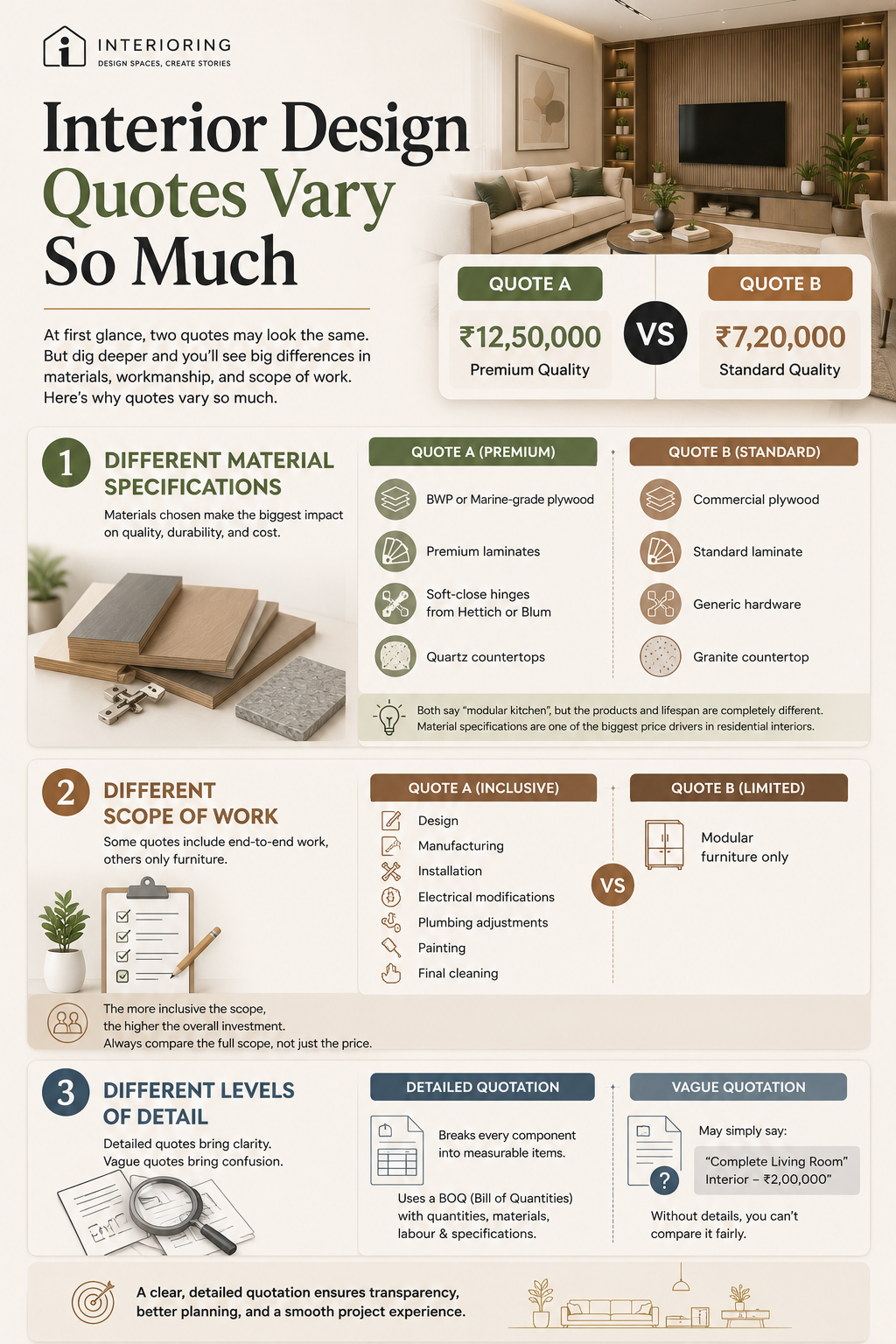
When you take a look at first glance both the quotations appear to cover the same project but at a closer look you realise that there is a stark difference between materials, workmanship and scope of work, given below are some of the major reasons why quotes differ.
Different Material Specifications
One quote may include:
BWP or Marine-grade plywood
Premium laminates
Soft-close hinges from Hettich or Blum
Quartz countertops
Another may use:
Commercial plywood
Standard laminate
Generic hardware
Granite countertop
Whilst both the quotations say "modular kitchen” the products are completely different, due to which the costs are also completely different, material specifications are one of the biggest price drivers in residential interiors.
Different Scope of Work
Some designers tend to include the overall pricing of the interiors whilst other chose to include only the pricing of furniture and the like.
For example:
Quote A includes:
Design
Manufacturing
Installation
Electrical modifications
Plumbing adjustments
Painting
Final cleaning
Quote B includes only:
Modular furniture
And due to this naturally the second quotation B seems much much cheaper than quotation A .
Different Levels of Detail
A professional quotation breaks every component into measurable items.
A vague quotation may simply say:
Complete Living Room Interior – ₹2,00,000
Without knowing what that amount covers, you have no way of comparing it fairly.
Professionals use a Bill of Quantities (BOQ) to eliminate this ambiguity. A detailed BOQ standardizes pricing by listing measurable quantities, materials, labor, and specifications, allowing multiple contractors to quote on the same scope.
What Is a BOQ?
BOQ stands for Bill of Quantities.
A good analogy to understand the BOQ is that it is the blueprint for pricing and instead of giving a lump-sum figure, a BOQ breaks the project into individual components with clear quantities , specifications and rates.
A typical BOQ might look like this:
Item Specification Quantity Rate Amount
Kitchen Base Cabinets BWP Plywood, Laminate Finish
28 sq.ft ₹2,800 ₹78,400 Wall Cabinets BWP Plywood
20 sq.ft ₹2,900 ₹58,000 Wardrobe BWP Ply + Laminate
70 sq.ft ₹2,700 ₹1,89,000 TV Unit Laminate Finish
18 sq.ft ₹2,600 ₹46,800 False Ceiling Gypsum Board
220 sq.ft ₹145 ₹31,900
With the BOQ each item has a measurable and this makes comparing different quotations much easier because you will be evaluating the same work rather than two completely different interpretations of that work.
What Should Always Be Included in an Interior Quote?
A reliable Interior Quotation should consist of -
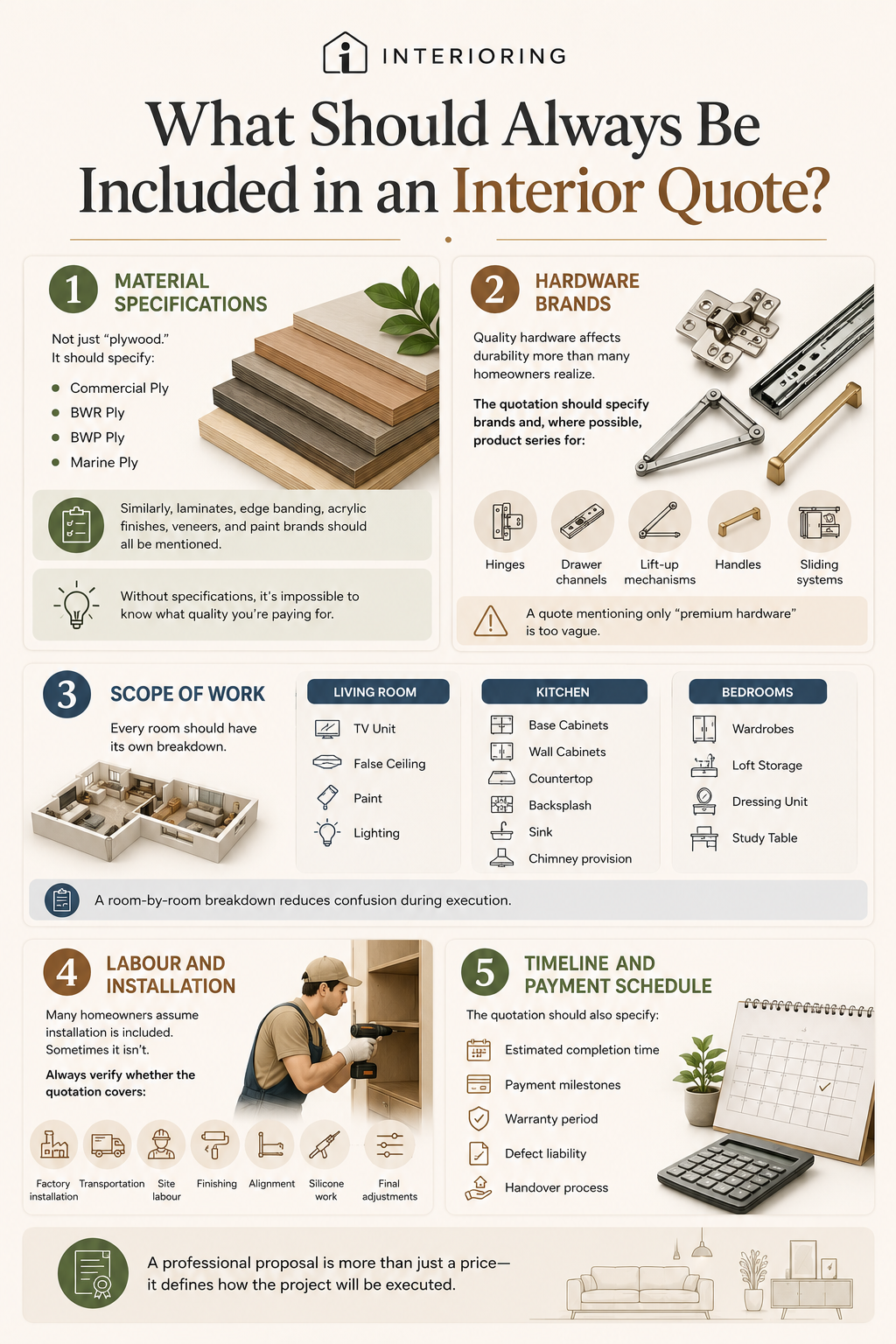
1. Material Specifications
Not just "plywood."
Instead, it should specify:
Commercial Ply
BWR Ply
BWP Ply
Marine Ply
Similarly, laminates, edge banding, acrylic finishes, veneers, and paint brands should all be mentioned.
Without specifications, it's impossible to know what quality you're paying for.
2. Hardware Brands
Quality hardware affects durability more than many homeowners realize.
The quotation should specify brands and, where possible, product series for:
Hinges
Drawer channels
Lift-up mechanisms
Handles
Sliding systems
A quote mentioning only "premium hardware" is too vague.
3. Scope of Work
Every room should have its own breakdown.
For example:
Living Room
TV Unit
False Ceiling
Paint
Lighting
Kitchen
Base Cabinets
Wall Cabinets
Countertop
Backsplash
Sink
Chimney provision
Bedrooms
Wardrobes
Loft Storage
Dressing Unit
Study Table
A room-by-room breakdown reduces confusion during execution.
4. Labor and Installation
Many homeowners assume installation is included.
Sometimes it isn't.
Always verify whether the quotation covers:
Factory installation
Transportation
Site labor
Finishing
Alignment
Silicone work
Final adjustments
5. Timeline and Payment Schedule
The quotation should also specify:
Estimated completion time
Payment milestones
Warranty period
Defect liability
Handover process
A professional proposal is more than just a price—it defines how the project will be executed.
What's Commonly Excluded?
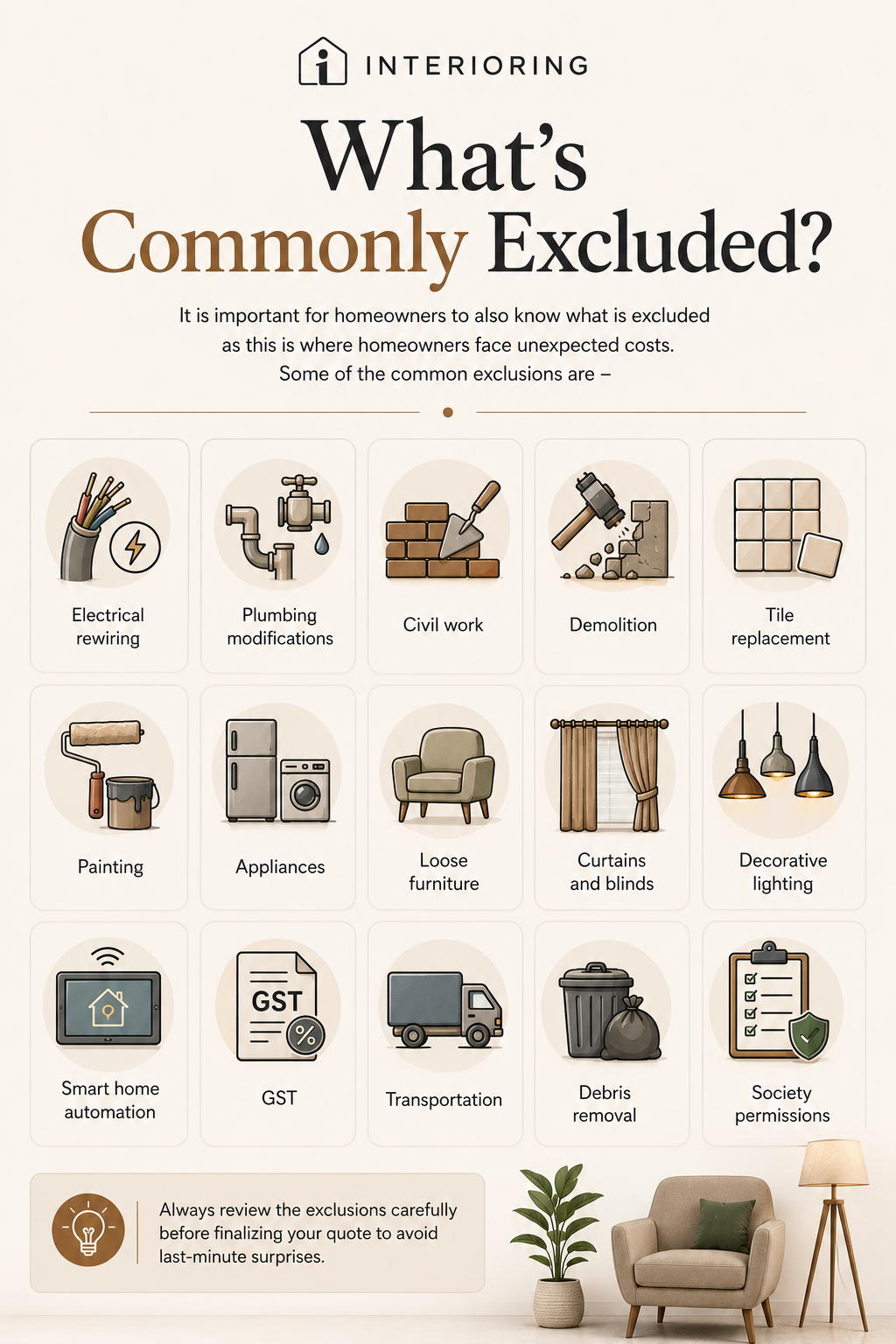
It is important for homeowners to also know what is excluded as this is where homeowners face unexpected costs some of the common exclusions are-
Electrical rewiring
Plumbing modifications
Civil work
Demolition
Tile replacement
Painting
Appliances
Loose furniture
Curtains and blinds
Decorative lighting
Smart home automation
GST
Transportation
Debris removal
Society permissions
Whilst these exclusions aren't really a problem, it is very important that they should be written down clearly, hidden exclusions are one of the most common reasons projects exceed their original budgets. Industry guidance and homeowner experiences consistently highlight omitted services, installation, taxes, and utility modifications as major sources of surprise costs.
Red Flags to Watch Out For
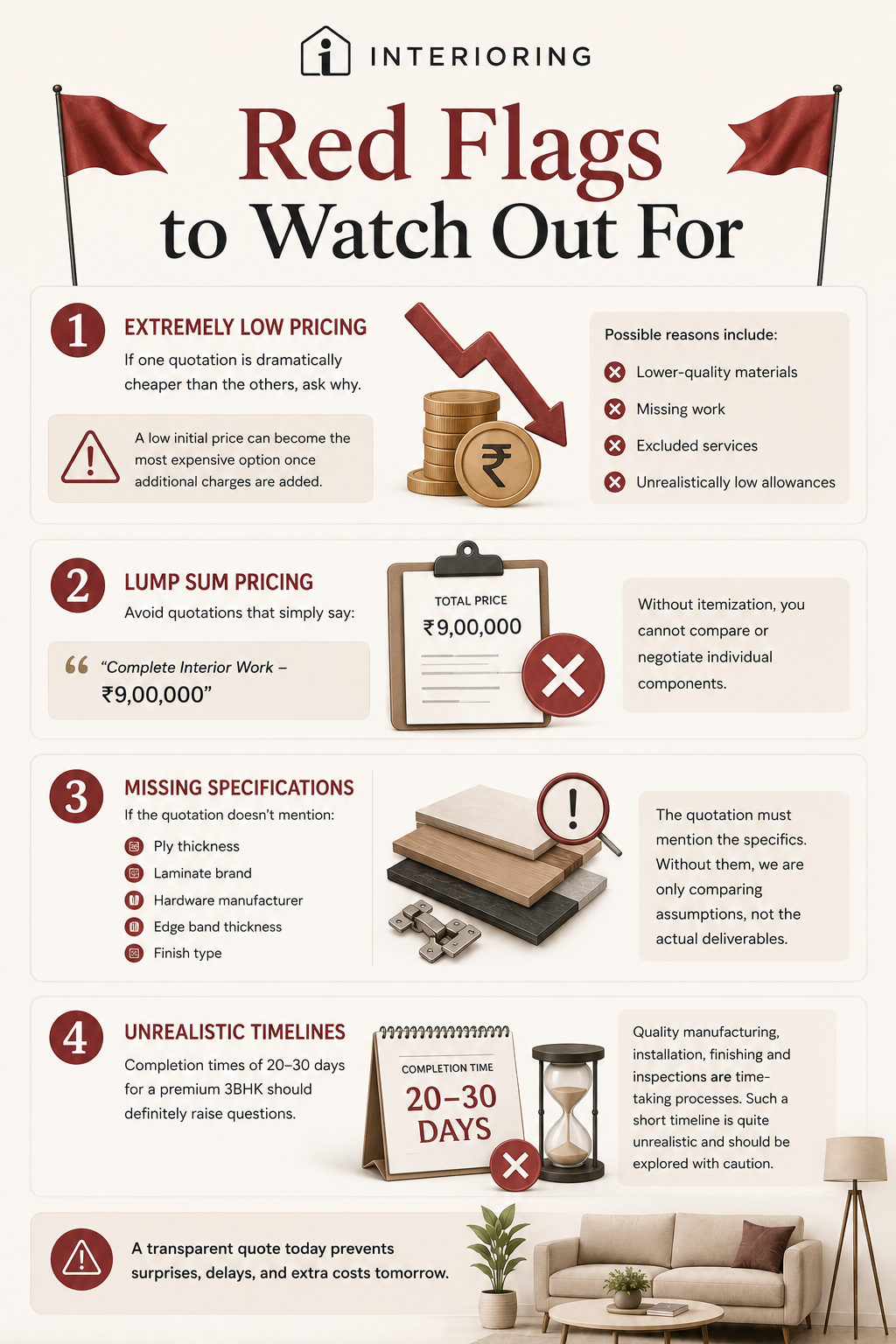
Extremely Low Pricing
If one quotation is dramatically cheaper than the others, ask why.
Possible reasons include:
Lower-quality materials
Missing work
Excluded services
Unrealistically low allowances
A low initial price can become the most expensive option once additional charges are added.
Lump Sum Pricing
Avoid quotations that simply say:
"Complete Interior Work – ₹9,00,000"
Without itemization, you cannot compare or negotiate individual components.
Missing Specifications
If the quotation doesn't mention:
Ply thickness
Laminate brand
Hardware manufacturer
Edge band thickness
Finish type
The quotation must mention the specifics without the mention of the specifics we would only have the opportunity to compare assumptions and not the actual deliverables.
Unrealistic Timelines
Completion times of 20-30 days for a premium 3BHK should definitely raise questions as quality manufacturing,installation,finishing and inspections are time taking processes and such a short timeline is quite unrealistic and hence should be explored with caution.
The Best Way to Compare Quotes
Instead of comparing the totals one should use something like a checklist given below-
Category Quote A Quote B Quote C
Kitchen Included ✔ ✔ ✔
Wardrobes ✔ ✔ ✔
False Ceiling ✔ ✖ ✔
Electrical Work ✔ Extra Extra
Painting Included Excluded Included
Hardware Brand Mentioned ✔ ✖ ✔
BOQ Provided ✔ Partial ✔
Warranty 10 Years 5 Years 5 Years
Checklists like these give one the ability to cross check and get a better look at the overall idea, in many cases the expensive quotation simply includes more work.
Questions Every Homeowner Should Ask
Some common questions you must ask your designer before signing any agreement are:
Can you provide a detailed BOQ?
Which items are excluded?
Are installation and transportation included?
What plywood and hardware brands are being used?
Are taxes included?
What happens if I request design changes?
How are additional works priced?
What warranty do I receive?
What is the payment schedule?
Can I see a sample contract?
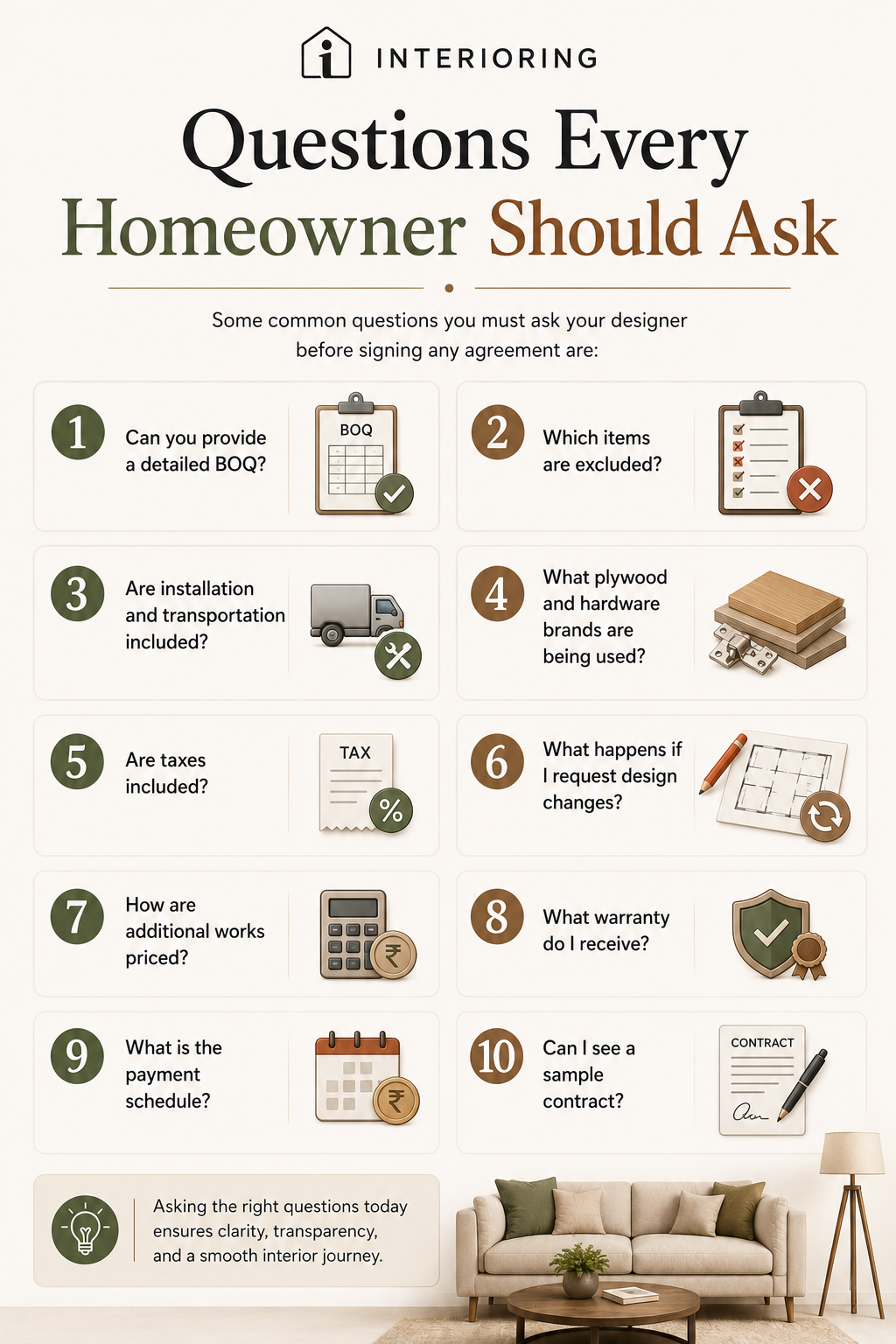
Clear answers today prevent disagreements tomorrow.
An interior quotation isn't just a price it's a promise of what will be delivered.The cheapest quote isn't always the best value, and the most expensive one isn't automatically overpriced.The key is understanding exactly what you're paying for.
It’s very important to remember that you aren’t just buying wardrobes and cabinets for your rooms, you are investing in your home for years to come and one must make sure that this investment pays itself off, hence one should approach Interior quotations with caution and knowledge.
Looking for Interior Design Help?
Connect with top-rated interior professionals in your city. Browse portfolios, compare styles, and get free quotes.