
Interior Design Contract Checklist: Everything That Should Be in Writing
Don't just review the quotation, review the contract. Here's the complete 8-point checklist every interior design agreement should include.
By
Interioring Editorial TeamImagine that you have finalized your interior designer, approved the quotation, and are excited to see your dream home come to life but then as a few weeks pass problems begin to appear The designer says the TV unit wasn't included, The contractor claims electrical modifications cost extra, The timeline suddenly increases by two months, Material upgrades push the budget higher than expected, Nobody can agree on who approved the changes.
Situations like these are actually far more common than homeowners realize and they tend to learn it the hard way, the difference between a smooth interior project and a stressful one more often than not comes down to a single document being the contract.
A properly formatted interior design contract protects both the homeowner and the designer by clearly defining the expectations, responsibilities, timelines, costs, and procedures before the work begins. Industry experts consistently identify that unclear contracts are one of the leading causes of disputes in interior design projects, and one of the major reasons why Interior Design projects tend to be delayed.
Let us first understand why an Interior Design contract is even important in the first place, many homeowners focus heavily on the quotation but pay very little attention to the contract itself and this is a major mistake whilst the quotation tells you how much you should pay it is the contract which grinds out the details of What you are paying for, when you will have to pay, when the work will reach completion or the assumed dates, What happens if things have to change and also how disputes will be handled, and without all of these details misunderstandings and mistakes will become inevitable, The contract serves the purpose of a rulebook for the entire project.
Let’s dive in to see what makes a Good Contract.
1. Scope of Work
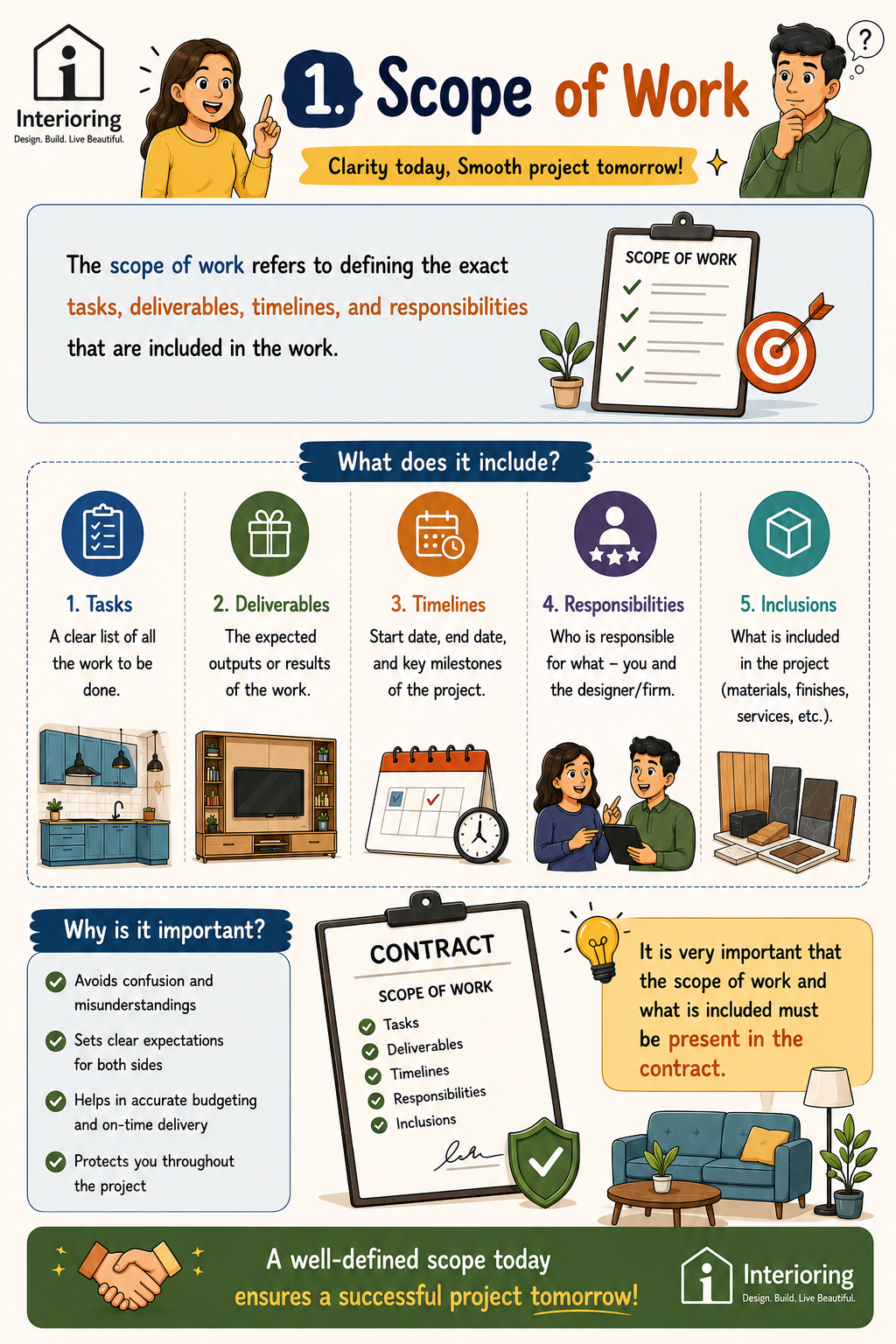
The scope of work refers to defining the exact tasks deliverables, timelines, and responsibilities that are included in the work, it is very important that the scope of work and what is included must be present in the contract.
It should clearly specify things like:
Rooms Included
For example:
Living room
Kitchen
Master bedroom
Guest bedroom
Utility area
Deliverables Included
Examples:
Modular kitchen
Wardrobes
TV unit
False ceiling
Lighting design
Painting
Services Included
Examples:
Site measurements
2D layouts
3D visualizations
Material selection
Project supervision
It is also equally as important that the contract should clearly state what is not included. Industry contract experts repeatedly emphasize that exclusions are just as important as inclusions, some common exclusions are
Civil work
Structural modifications
Plumbing
Electrical rewiring
Appliances
Decorative accessories
The more detailed the scope of the work is there is lesser there is an opportunity for disputes to arise once construction has started.
2. Project Timeline and Milestones
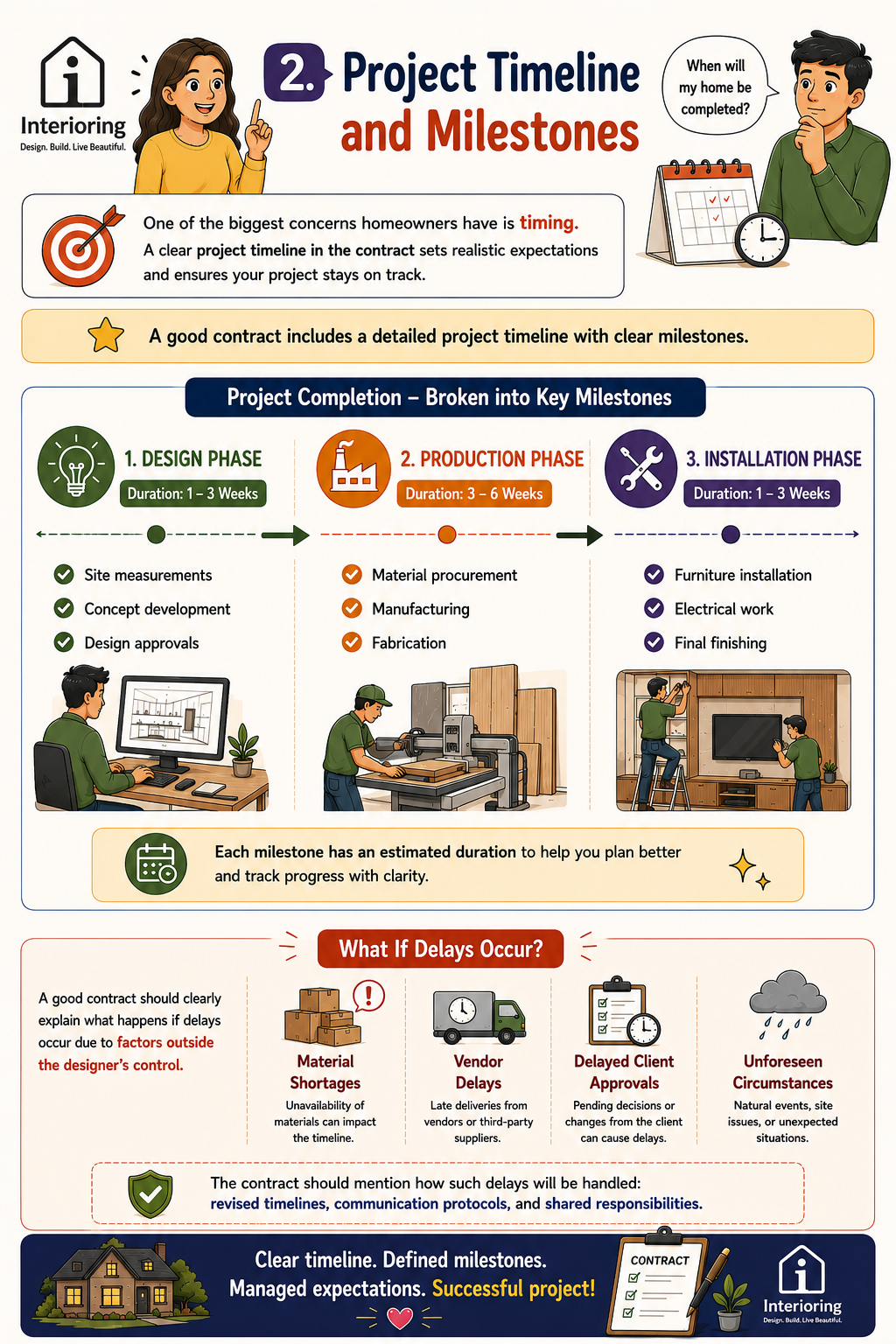
One more major issue that tends to arise is project completion on time and it is very important for the contract to consist of a project timeline, as one of the biggest concerns that homeowners tend to have is when their home will be completed, setting realistic expectations through a project timeline mentioned in the contract is very important.
Project completion must also be broken into milestones such as
Design Phase
Site measurements
Concept development
Design approvals
Production Phase
Material procurement
Manufacturing
Fabrication
Installation Phase
Furniture installation
Electrical work
Final finishing
A good contract should also explain what happens if delays occur due to factors outside the designer's control, such as material shortages, vendor delays, or delayed client approvals.
3. Payment Terms and Payment Schedule
Another one of the most common sources of conflict is that of payment and the payment schedule, a good payment schedule is often broken into milestones and is broken down throughout the entire project for the benefit of both the parties involved, it is often structured as given below -
Advance Payment
How much is payable before work begins?
Milestone Payments
When are additional payments due?
Many firms use milestone-based payment structures tied to project progress.
A typical structure may look like:
10–20% advance
Payment after design approval
Payment before manufacturing
Payment during installation
Final payment at handover
Final Payment Conditions
This section is particularly important.
The contract should specify:
When the final payment becomes due
Whether snagging items must be completed first
What constitutes project completion
Without clear payment milestones, misunderstandings can arise on both sides.
4. Detailed Pricing and Cost Breakdown
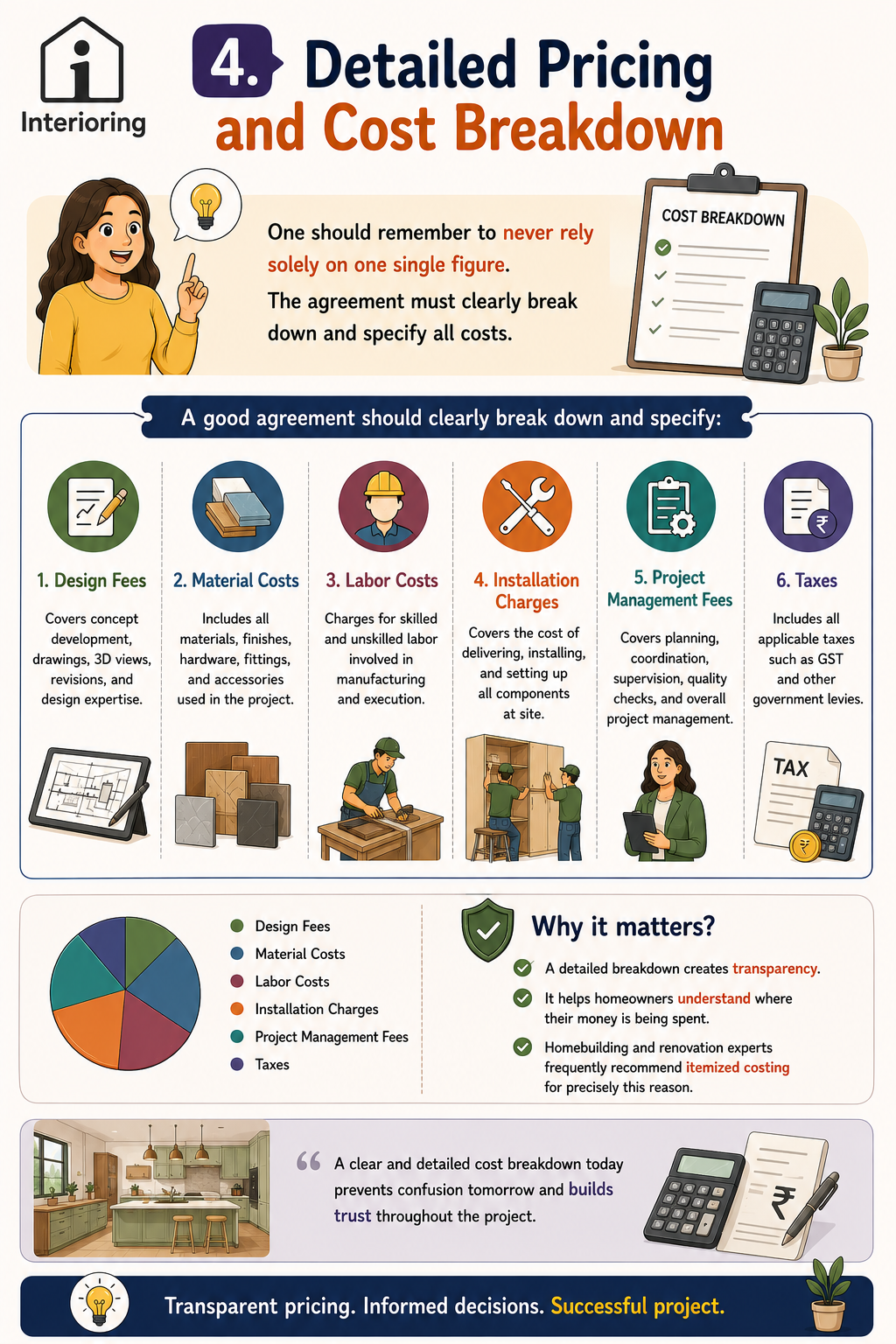
One should remember to never rely solely on one single figure and the agreement must clearly break down and specify the Design fees, Material costs, Labor costs, Installation charges, Project management fees and Taxes.
A detailed breakdown creates transparency and helps homeowners understand where their money is being spent. Homebuilding and renovation experts frequently recommend itemized costing for precisely this reason.
5. Material Specifications
This section prevents one of the most common project disputes.
The contract should clearly identify:
Materials
Examples:
Plywood grade
MDF or HDHMR
Laminate brands
Veneer specifications
Hardware
Examples:
Hinges
Channels
Drawer systems
Lift-up mechanisms
Finishes
Examples:
Laminate finish
Acrylic finish
PU finish
Veneer finish
Without documented specifications, homeowners may receive products different from what they expected.
6. Change Requests and Variations
Every interior project experiences some changes and it is imperative for the contract to mention who will handle these changes.
What Qualifies as a Change Request
Examples:
Adding a new unit
Changing materials
Modifying dimensions
Altering layouts
Approval Process
Changes should never be approved verbally, every variation/change must be documented and signed off before the work begins.
Impact on Budget
The contract should explain:
Additional costs
Revised quotations
Extra material charges
Impact on Timelines
Changes often cause delays.
This should be acknowledged upfront.
Industry professionals consistently identify uncontrolled change requests as one of the biggest causes of project overruns and client disputes and recommend that one must only allow a certain amount of changes in the project.
7. Site Supervision Responsibilities
Many homeowners assume the designer they meet initially will personally oversee the entire project but that's not always the case and is very important that the contract should state clearly, Who supervises the site, Who conducts inspections, Who coordinates contractors, Who approves installations this ensures to create accountability throughout the project.
8. Project Delays and Dispute Resolution
No project starts expecting problems, but good contracts always have failsafe in the situations that disputes or project delays do arise.
The agreement should explain:
Delays
What happens if the designer is delayed?
What happens if the homeowner delays approvals?
Dispute Resolution
The contract should define:
Escalation procedures
Mediation processes
Legal jurisdiction
Having these procedures documented protects both parties if disagreements occur.
Interior Design Contract Red Flags
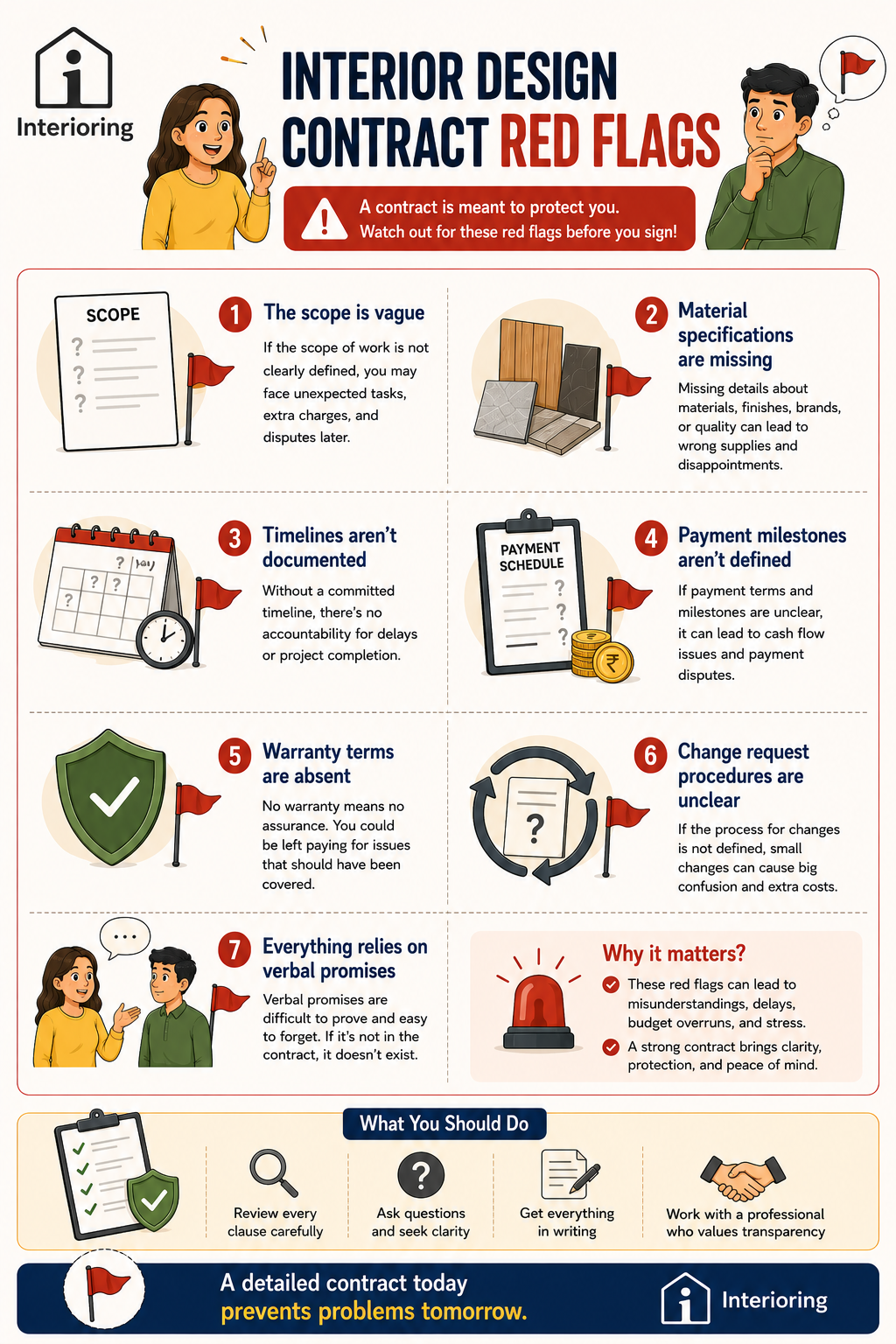
Some major Red flags when it comes to interior design contracts are :
The scope is vague
Material specifications are missing
Timelines aren't documented
Payment milestones aren't defined
Warranty terms are absent
Change request procedures are unclear
Everything relies on verbal promises
A beautiful design means very little if the project is plagued by misunderstandings, delays, and unexpected costs.
A well-drafted interior design contract creates clarity from day one by defining the scope of work, payment terms, timelines, warranties, material specifications, and change request procedures. Most project disputes don't arise because people are dishonest—they arise because expectations were never properly documented.
Before starting your next interior project, don't just review the quotation.
Review the contract.
Because when everything important is in writing, both homeowners and designers can focus on what truly matters: creating a home that meets expectations, stays on budget, and is delivered with confidence.
Looking for Interior Design Help?
Connect with top-rated interior professionals in your city. Browse portfolios, compare styles, and get free quotes.