Interior Designer vs Contractor: Which One Should You Hire?
Confused between hiring an interior designer or a contractor? Compare costs, roles, and risks to find the right fit for your home project.
By
Interioring Editorial TeamOne of the most persistent problems homeowners face when planning a New home or renovating an existing one is whether to hire an Interior Designer or a Contractor.
People tend to assume that both of these roles are interchangeable, whilst being a natural assumption due to both being involved in creating and improving spaces, they serve entirely different roles in reality, hiring the wrong professional can lead to budget overruns, design compromises, unnecessary delays, and costly mistakes.
In this guide we breakdown the key differences between an Interior Designer and a Contractor, the guide will also explain when each option makes sense and compare costs to help you find the best choice for your home.
Understanding the Difference Between an Interior Designer and a Contractor
A nice analogy that can be used to understand the difference between an Interior Designer and a Contractor is to think that the Home is a movie, The Interior Designer is the Director of this movie who creates the vision, plans the details, and ensures every element works together harmoniously. The contractor is the production team that executes the plan and brings that vision to life, and just like in a movie both of the roles are different and also very essential to make the home-project a success
A deeper look into the differences between the two tells us that -
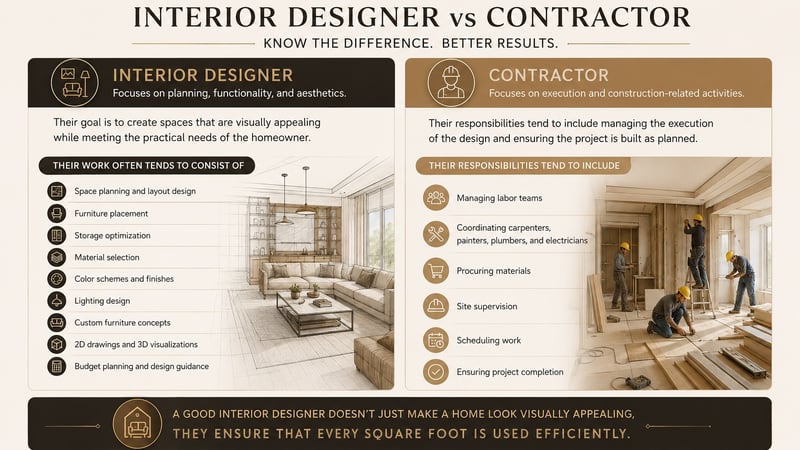
An interior designer focuses on planning, functionality, and aesthetics. Their goal is to create spaces that are visually appealing while meeting the practical needs of the homeowner. Their work often tends to consist of - Space planning and layout design, Furniture placement, Storage optimization, Material selection, Color schemes and finishes, Lighting design, Custom furniture concepts, 2D drawings and 3D visualizations and Budget planning and design guidance
A Good Interior designer doesn’t just make a home look visually appealing, they ensure that every square foot is used efficiently.
A Contractor focuses on the execution and construction-related activities, Their Responsibilities tend to include - Managing labor teams, Coordinating carpenters, painters, plumbers, and electricians, Procuring materials, Site supervision, Scheduling work, Ensuring project completion.
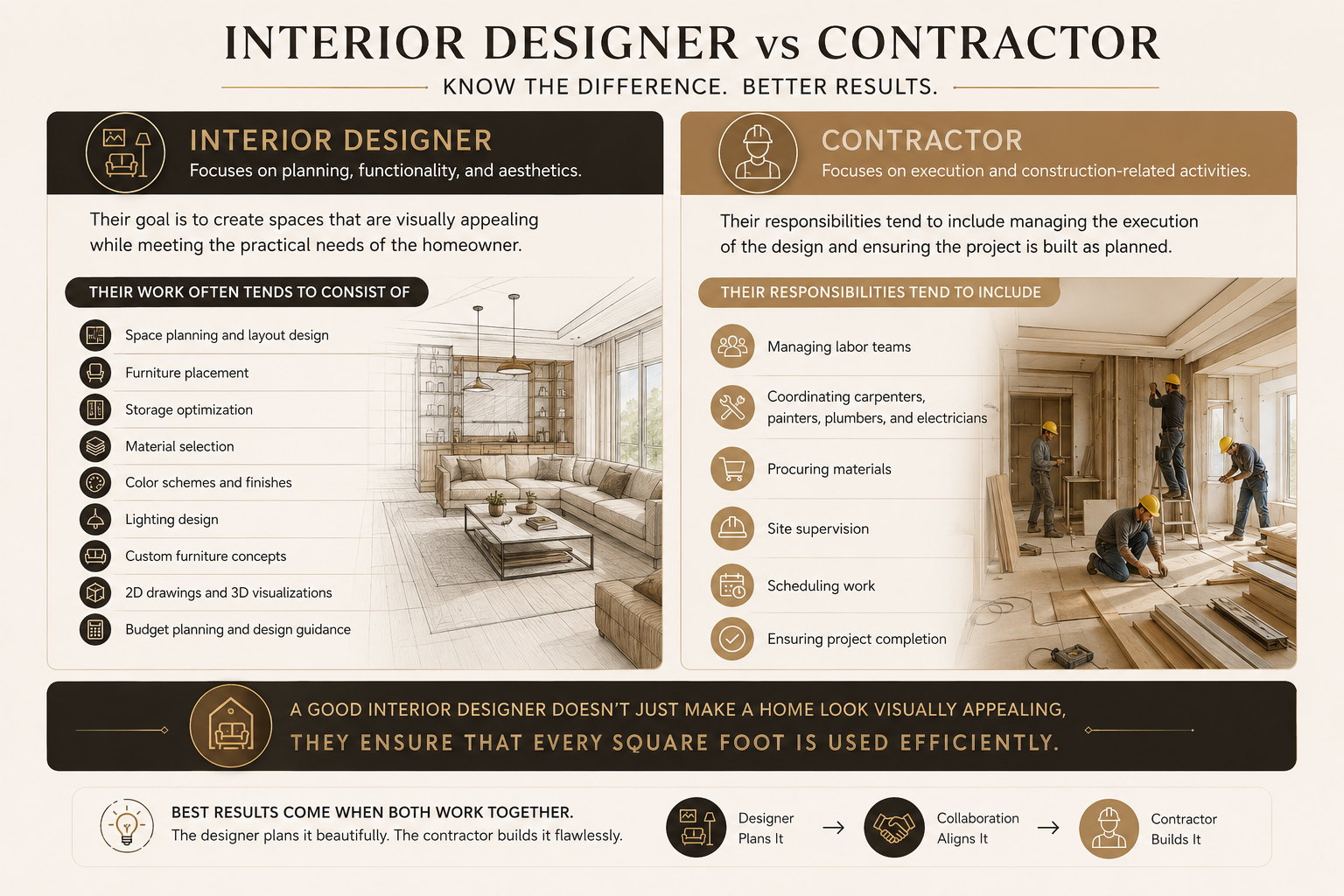
The most basic difference between an Interior Designer and a Contractor is that contractors focus on building and installation rather than design planning.
When Should You Hire an Interior Designer?
Whilst an Interior designer is not required for every project, hiring an Interior Designer can significantly improve the final outcome of the project.
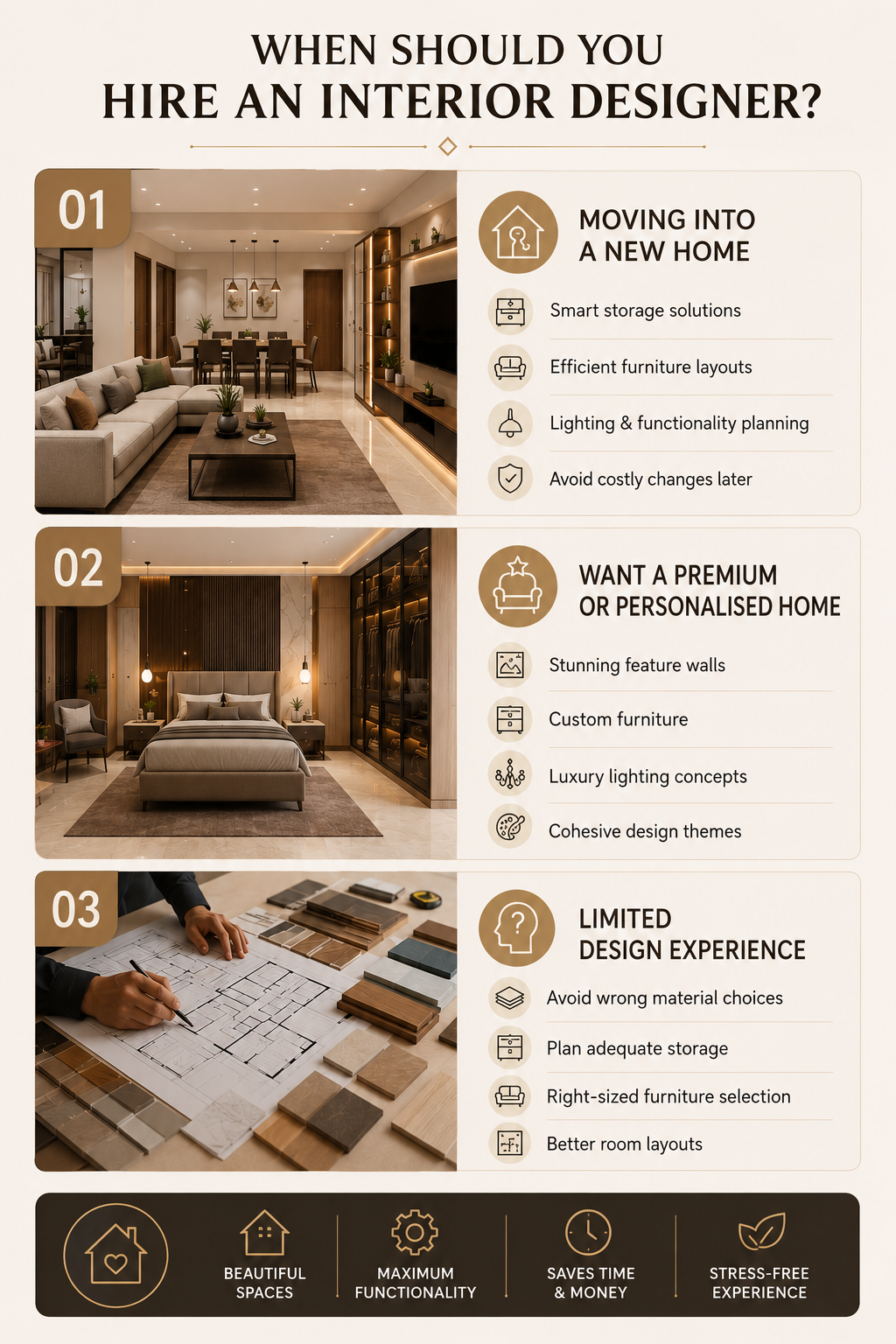
When you are moving into a New Home : If you are a new homeowner and have very recently acquired possession of a 2BHK, 3BHK or Villa hiring an Interior Designer will maximize your investment as Interior Designers can plan Storage solutions, Furniture layouts, Lighting concepts, Room functionality before any work begins, this prevents costly modifications later.
You Want a Premium or Personalized Home : If your priority is to have a Aesthetically pleasing and a Visually appealing home hiring an Interior Designer is often worth your investment as Interior designers can create, Feature walls, Customized furniture, Luxury lighting concepts, Cohesive design themes that are difficult to achieve without professional planning.
You have limited Design Experience : Most homeowners will only renovate once or twice in their lives, this lack of prior experience can often lead to them making mistakes such as Choosing the wrong materials, Underestimating storage needs, Selecting furniture that doesn't fit properly, Creating awkward room layouts, an experienced designer helps avoid these common pitfalls.
When Is a Contractor Enough?
While interior designers offer significant advantages, there are situations where hiring only a contractor may be sufficient.
You're handling Simple Renovations: For straightforward projects such as, Repainting walls, Replacing tiles, Installing a basic false ceiling, Minor repairs a contractor is often all you need.
You Already have a Clear Design Plan: Some homeowners know exactly what they want, when you already have Detailed drawings, Material specifications, Layout plans, then a contractor can execute the project without requiring additional design services.
Your priority is Cost Savings: Contractors generally have lower upfront costs compared to hiring a designer, If your primary goal is functionality rather than aesthetics, working directly with a contractor may be the more economical option.
Interior Designer vs Contractor: Cost Comparison
One of the biggest tiebreakers when it comes to the cost and the difference between the two.
A Contractor will typically only charge for The labor, material procurement and Project execution, though this seems far more affordable on face value one must remember that they are only paying for the construction and installations making the homeowners the ones responsible for the design decisions. Advantages to hiring a Contractor are Lower upfront costs, Simpler pricing structures, Faster project initiation.
An Interior Designer will charge for Fixed design fees, Percentage-based fees, Project management fees, Turnkey package pricing, this will increase the initial budget pricing it also provides you access to professional planning and design Expertise.
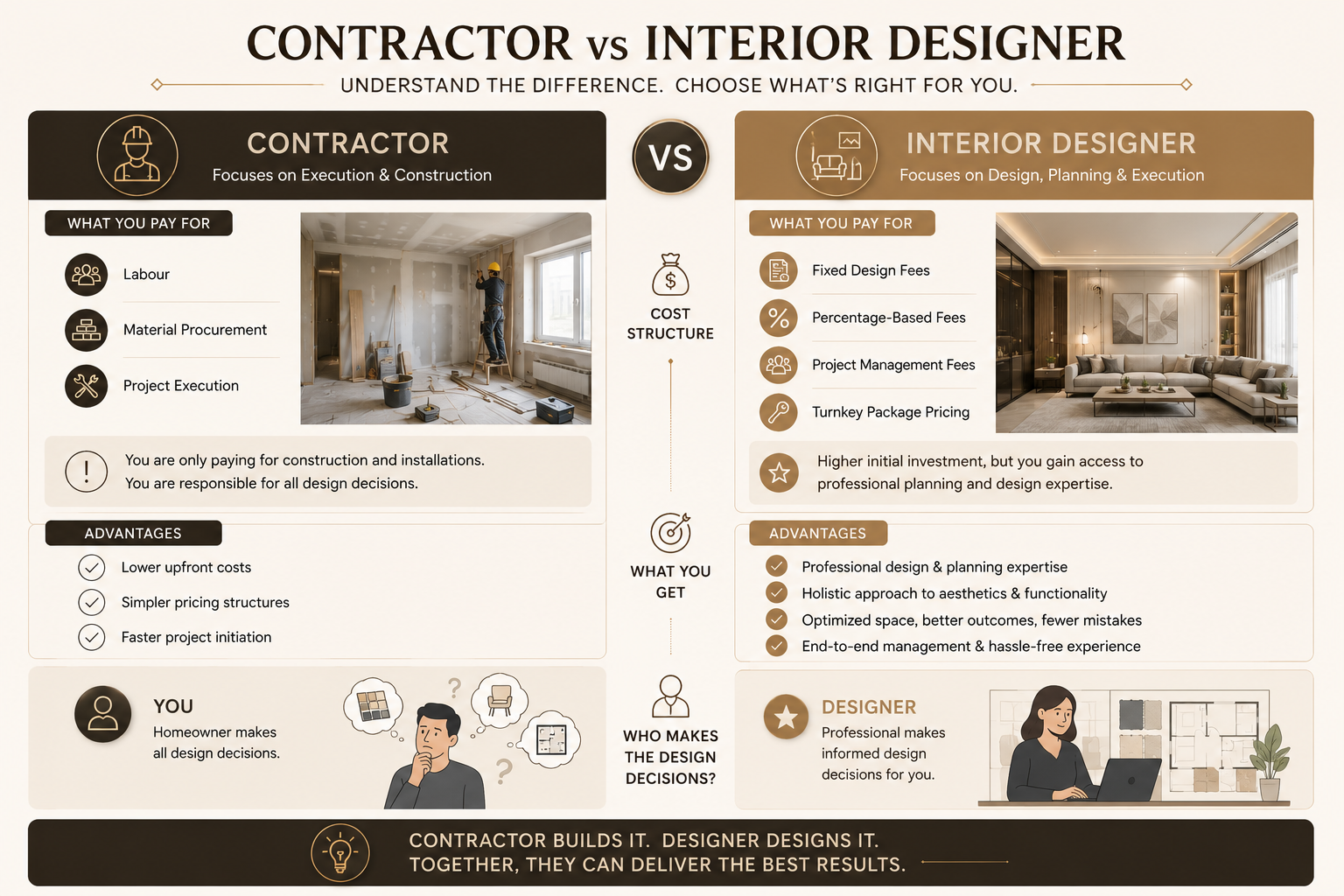
Many homeowners find that investing in design services helps reduce costly mistakes later in the project, the cheapest option upfront isn't always the most cost-effective option in the long run.
Risks of Hiring Only a Contractor
Working solely with a contractor can be effective for simple projects, but there are potential drawbacks such as-
Poor Space Planning: Without professional input homeowners tend to encounter spacing problems such as Insufficient storage, Poor furniture placement, Wasted space, Inefficient room layouts, these problems can become extremely difficult and expensive to fix once construction is completed.
Inconsistent Design: Homeowners tend to get their inspirations from various sources be it social media, magazines or websites but without a clear design strategy the final home can feel very disconnected with different styles competing against one another for attention.
Increased Decision Fatigue: A contractor will typically ask you to make numerous decisions regarding, Materials, Finishes, Hardware, Lighting, Paint colors, For many homeowners, this process quickly becomes overwhelming.
Costly Mid-Project Changes: The lack of experience of the Homeowner when it comes to how different elements act together to create one cohesive design often leads to a trial and error method and when design decisions are made during construction rather than before it, modifications can become expensive and time-consuming.
Choosing between an interior designer and a contractor isn't about deciding which of the two professionals is better but about which of them is more apt for your project.
A contractor can be an excellent choice for simple, functional renovations and for those who are prepared. However, if you're investing in a new home and want a space that balances beauty, functionality, and long term value, an interior designer can provide expertise that ensures minimal mistakes and a project that will pay back its own worth by its practicality.
Ultimately, the best homes are often the result of strong planning and skilled execution. By understanding the unique role each professional plays, you can make a more informed decision and create a home that truly meets your needs.
Looking for Interior Design Help?
Connect with top-rated interior professionals in your city. Browse portfolios, compare styles, and get free quotes.